Kauai's Na Pali Coast: Facts Most Boat Passengers Never Hear
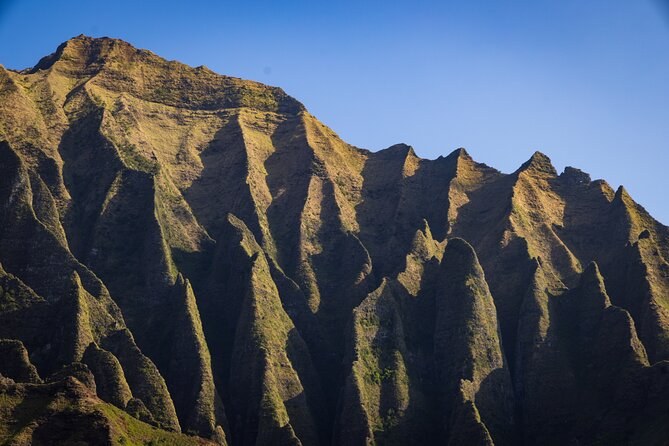
The short answer. The Na Pali Coast was closed for more than a year after a flood, its valleys were once taro farms, kayaks may paddle it only in summer, and no catamaran may land on it. Most passengers on a Kauai sailing trip hear the cliffs described and none of this. Here are the facts, with where each one comes from.
Two numbers nobody official prints
Ask anyone about this coast and you get two numbers: its length in miles and the height of its cliffs. The boat companies disagree on both, and the state's park pages give neither. We leave them out. What follows is what the state, NOAA and the published records say.
Fourteen facts about the coast and its waters
1. It was shut for over a year by a flood.
DLNR closed Haena State Park and the Na Pali park from April 2018 to June 2019 after severe flooding on the north shore. The closure let the state bring in the reservation system hikers use today.
2. The valleys were farms.
DLNR notes stone-walled terraces still standing on the valley floors, where Hawaiians once grew taro. Wikipedia dates the first settlers to Polynesian navigators around 1200 AD.
3. Kayaks get a summer window only.
The state allows paddling the coast only from 15 May to 7 September. The rest of the year the sea is too unpredictable, and even in summer paddlers go east to west with the currents and trade winds.
4. Only rafts may land, at one beach.
Of all the boats on this coast, only the permitted raft tours may put passengers ashore, at Nualolo Kai. Catamarans, however large, stay off the sand.
5. Boat drop-offs for campers are illegal.
No one may run a commercial boat drop-off to the Kalalau or Milolii camping areas. DLNR asks visitors not to hire the operators who do it anyway.
6. The caves follow cracks in the rock.
Wikipedia notes that the large sea caves of this coast formed along dikes: seams of volcanic rock that cut through the older layers, which the sea has worn hollow.
7. Much of the coast has no trail at all.
Between Kalalau Beach and Polihale, Wikipedia says, no one can walk in. The boat is the only way along that stretch, bar a helicopter.
8. Half the North Pacific's humpbacks winter here.
NOAA's sanctuary says more than half of the humpback whales in the North Pacific use Hawaii's waters to breed and calve. Boats must keep 100 yards away.
9. The dolphins have their own distance rule.
Since 2021, a NOAA rule keeps people and boats at least 50 yards from spinner dolphins within 2 nautical miles of the shore of the main islands.
10. The park has no water, bins or signal.
DLNR provides no drinking water, trash service or cell phone service anywhere in the park. Five composting toilets serve the whole coast, from Hanakapiai to Milolii.
11. Hikers need a camping permit even to walk.
Beyond Hanakapiai Beach, 2 miles in, you need a camping permit whether or not you camp. The only campsites on the trail are at Hanakoa and Kalalau.
12. Boats also leave from the north shore.
Wikipedia lists charter tours from Hanalei Bay as well as Port Allen. Every boat on our list leaves from the south and east shores.
13. A seal you may meet is one of the rarest.
NOAA calls the Hawaiian monk seal one of the most endangered seal species in the world. Travellers have met one at the snorkel stop; give it space.
14. Sunset moves by almost 90 minutes.
Hawaii keeps no daylight saving time. At Port Allen the sun sets around 5:56 p.m. in mid-November and 7:24 p.m. in mid-July, by USNO's tables.
Where each fact comes from
| Fact | Source |
|---|---|
| Flood closure, terraces, landings, permits | DLNR, Division of State Parks |
| Kayak season | DLNR boating page |
| Whales and the 100-yard rule | NOAA humpback whale sanctuary |
| Dolphin rule and the monk seal | NOAA Fisheries |
| Sunset times | U.S. Naval Observatory |
| Settlers, cave geology, harbours | Wikipedia |
What the facts mean for your trip
Three of them change how you book. First, the landing rule: if you want to stand on a Na Pali beach, a catamaran will not get you there. Second, the season: the state's summer kayak window is the best public sign of when the sea is calmest. Third, the light: an evening trip in November finishes long before one in July.
The rest are for the deck. Your crew will point out the valleys, and you will know which ones the trail reaches and which only a boat can. You will know why the terraces are there, and why the raft you may see on the beach at Nualolo Kai is allowed and your catamaran is not. And if a dolphin pod or a whale comes close, you will know it is the animal, not the boat, that is allowed to close the gap.
- Want a beach? Only a permitted raft or the trail gets you onto one.
- Want whales? Book between November to April; no boat can promise one.
- Want calm water? Aim for 15 May to 7 September, and see Kauai weather by month.
- Want the sunset? Check the month on the best time to sail Kauai.
Where to see it for yourself
The whales and dolphins have their own page, with the distance rules in full: whales and dolphins on a Kauai sail. The caves have theirs too: the Na Pali caves. For the valleys one by one, read the coast from the water, valley by valley.
On the water, the Holo Holo morning sail sets its sails when the wind allows and costs $274 a person, with 7 days' notice to cancel. The Lucky Lady morning adds a waterslide and takes children from 3, at $233 a person.
Hear the stories from the deck
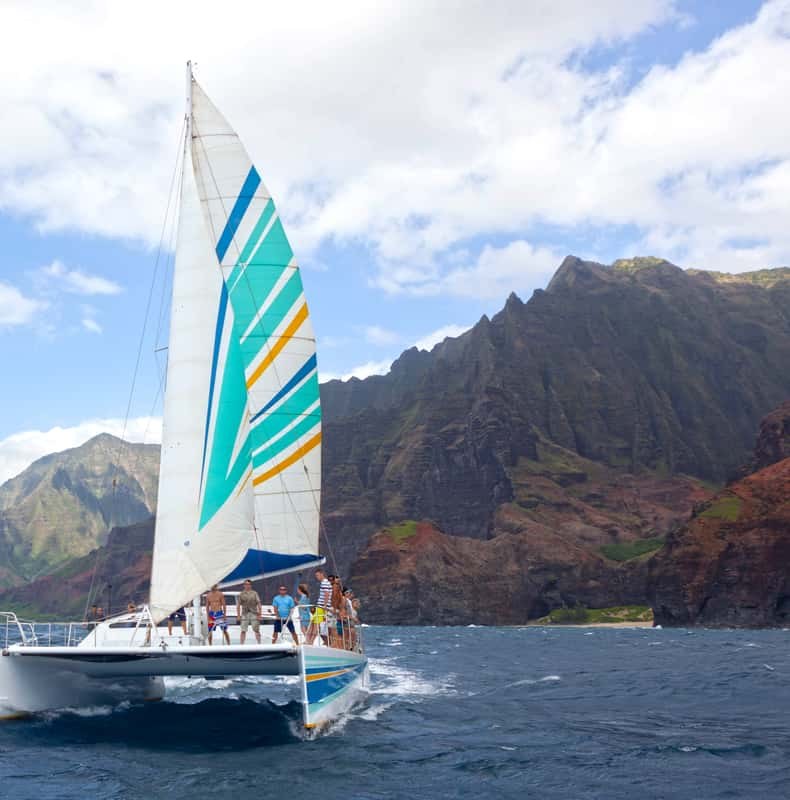
Kauai: Napali Coast Sail & Snorkel Tour from Port Allen
Five hours from Port Allen with breakfast and a deli lunch, a reef snorkel with gear and a waterslide, and sails when the wind allows. Cancel free up to 7 days ahead.
From $274 per person
Check Availability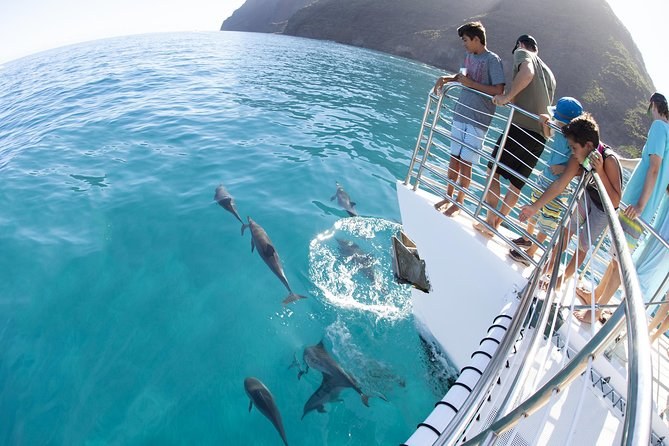
Kauai: Deluxe Na Pali Snorkel Cruise aboard Lucky Lady
Five and a half hours on a 60-foot catamaran from Port Allen, checking in at 6:45 a.m.: breakfast treats, a reef snorkel with gear, a waterslide and a sandwich lunch, with an open bar for over-21s. Children from age 3.
From $233 per person
Check Availability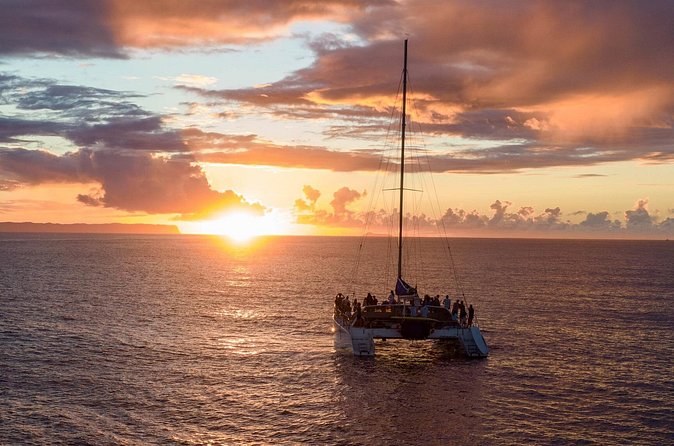
Kauai: Leila Na Pali Sunset Dinner Sail
Four to five hours from Port Allen on a 50-foot catamaran that sails when the wind allows: mai tais on the way out, dinner as the sun sets and a champagne toast. Up to 41 aboard.
From $263 per person
Check AvailabilityNext: Take the facts aboard: the crews tell the coast's history as you pass it. Every fare sits side by side on Kauai Sailing Tours.